 Flas
36 letters. Nine of them are written with two.
The Albanian alphabet, as every child in Albania and Kosovo learns it, built into Flas with a real voice for every letter and every example word. Tap a letter to hear its name; tap again to hear the word.
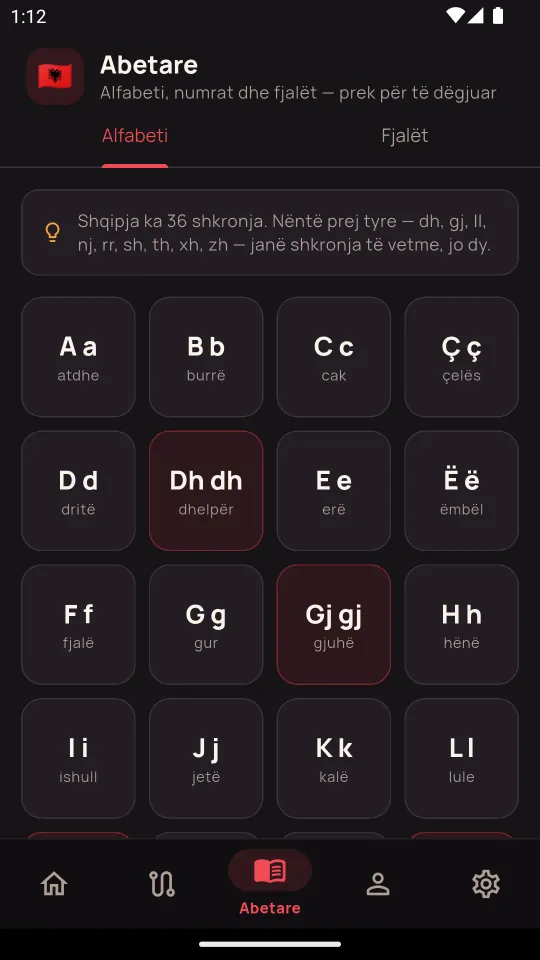
First tap: the letter. Second tap on the same card: the example word.
Dh, Gj, Ll, Nj, Rr, Sh, Th, Xh, Zh are letters, not pairs.
A child who learned to read in English, German or French sees "sh" and reads two sounds. In Albanian it is one letter with one sound, and it has its own place in the alphabet, its own name, and its own page in a first-year reading book. Flas treats them that way: each digraph is a single card, pronounced as a single letter, with its own example word.
Two more trip up diaspora kids: Ë, the most common letter in Albanian, which is often barely voiced at the end of a word; and Y, which is a vowel — the "ü" of German "über" — not the English "y". Both have their own card and their own voice clip, and the app's speaking exercises listen for exactly those sounds.
More than the alphabet.
The Abetare tab also holds the everyday reference a family reaches for mid-conversation, every word spoken:
- Ready-made phrases for a call or a visit — "Si jeni?", "Më mungon", "Të dua"
- The family — nëna, babai, gjyshja, daja, tezja, halla, xhaxhi
- Numbers 0–20, then the tens up to a thousand
- Colours, animals, food, the body
- Days of the week, months and seasons
Your first lesson is ten seconds away.
No account, no card. Learn on your own, or bring the whole family along.